Peter Smith

According to Jack Prandelli, the increase occurs because of a systemic reaction instead of separate national trends. And every country on this chart is printing more to survive an oil shock they didn't see coming.
Worldwide Debt Totals Increase Rapidly
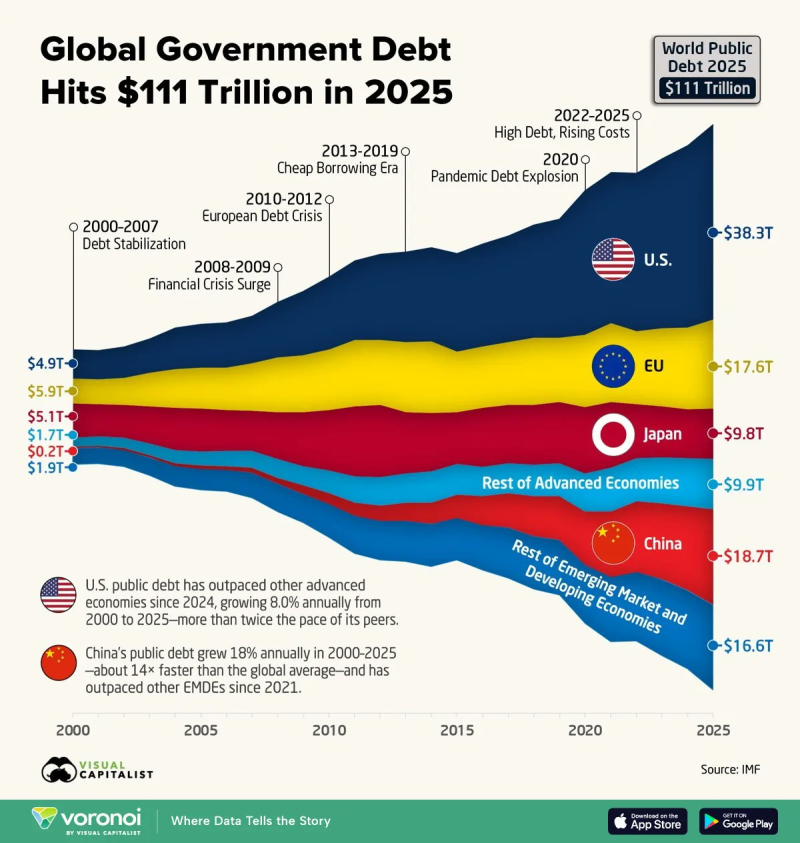
Recent data indicate that debt grows across many large economies - this supports the conclusion that the present cycle is global instead of specific to certain regions. The US is the largest source of this growth but rapid increases are also present in China and other large regions.
- 🇺🇸 US: $38.3T growing 8% annually
- 🇨🇳 China: $18.7T growing 18% annually, 14x faster than global average
- 🇪🇺 EU: $17.6T energy crisis hitting reserves
- 🇯🇵 Japan: $9.8T 80% of oil through blocked Hormuz
Prandelli describes how the trend is structural: “The debt machine never stops. But Hormuz just made every number on this chart worse”.
Energy Costs Create a Worldwide Feedback Process
At the center of this rapid increase is a macroeconomic reaction that connects energy, inflation and the costs of borrowing.
“Higher oil = higher inflation = higher rates = more debt cost” Prandelli explains.
By this process governments borrow more money when the conditions for financing become more restrictive - this cycle causes global debt to reach higher levels.
Central Banks Face Limited Options
The amount of global debt ensures that policymakers have little space to change their actions. And central banks are cornered.
As inflation pressures grow and the costs to pay for debt increase, central banks are in a situation where they must choose between price stability and financial stability.
A Significant Macroeconomic Subject for 2025
The $111 trillion total shows a change in the worldwide financial system where debt, energy markets and monetary policy connect more frequently. As Prandelli describes, the current situation creates strategic questions for markets:
- Why central banks are cornered right now
- The 1974 petrodollar handshake and why the Iran war is THE moment
- What Buffett's $373B cash pile is actually waiting for
- Where institutional capital is rotating
- Why every emerging-market central bank is buying gold except the Fed
- How to think about your portfolio today
With debt that continues to grow and energy risks that are not resolved, global markets are in a period where the ability to maintain this path is a primary concern.
 Peter Smith