Marina Lubimova
- Inflation Has Peaked. The Gap With 2% Has Not Closed
- Why Williams Opposed Another Increase
- The Hold Comes With a Clear Condition
- The Fed Is Treating the Oil Shock as Temporary
- Tariffs May Have Raised Prices Without Permanently Raising Inflation
- Market Pricing Is Not Fed Guidance
- AI Spending Is Inflationary at the Margin, Not a Systemic Threat
- The Data That Could Break Williams’ Forecast
- A Hold, Not an Easing Signal
I strongly supported the decision of the committee.
His support for the hold is conditional. Williams expects tariff and energy-related price pressures to weaken, but said the Fed should tighten again if inflation stops falling.
Inflation Has Peaked. The Gap With 2% Has Not Closed
Headline Personal Consumption Expenditures inflation slowed from 4.1% in May to 3.7% in June 2026. The index declined 0.1% month over month, its weakest reading since April 2020. Core PCE, excluding food and energy, rose 0.1% during the month and 3.3% from a year earlier. The direction supports Williams’ forecast. The level remains uncomfortable.
At 3.7%, headline inflation is still 1.7 percentage points above the Fed’s target and approximately 85% higher than the desired annual rate.
My forecast personally is for inflation to come down in the second half of this year and come down further next year.
Williams expects inflation to return to 2% on a sustained basis by 2028. That timeline implies a long period of restrictive rates rather than an imminent shift toward easing.
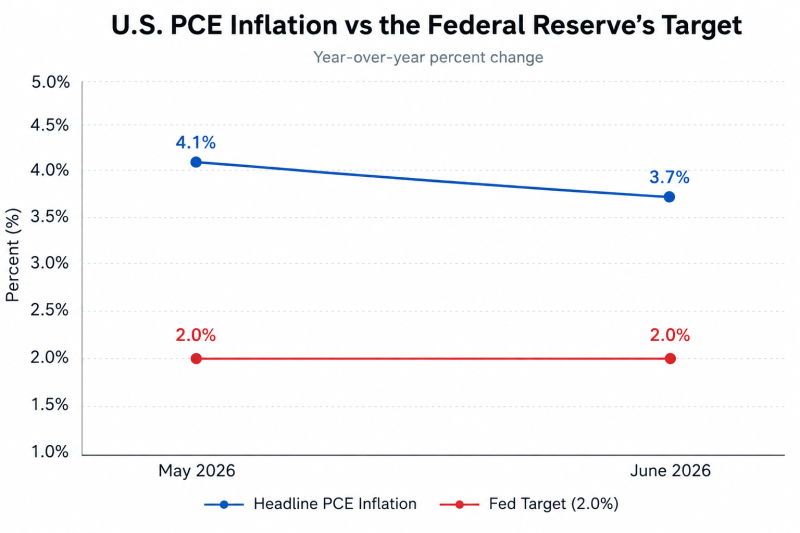
The latest decline is meaningful, but two monthly observations do not establish a durable disinflationary trend. The Fed needs evidence that core price growth is also moving consistently lower.
Why Williams Opposed Another Increase
The July FOMC kept rates unchanged, although three policymakers preferred a 25-basis-point increase. The hawkish case rests on the persistence of inflation. Cleveland Fed President Beth Hammack argued that price growth has remained above target for too long to assume it will correct without tighter policy.
Inflation has remained stubbornly above 2% for more than five years, and I am not confident it will return to our objective on its own.
Williams sees less evidence that domestic demand requires another increase.
The U.S. economy expanded by roughly 2% over the previous year, while the unemployment rate remained broadly stable. Neither growth nor labor-market conditions point to clear overheating.
We’re not seeing the economy show any signs of overheating in terms of labor market, in terms of growth.
Williams attributes much of the recent inflation to specific supply and investment shocks:
- tariffs passing through to consumer prices;
- higher oil and commodity prices;
- disruption linked to the Middle East;
- unusually strong AI infrastructure spending.
His conclusion is that the existing rate range can restrain demand while those effects fade.
Monetary policy currently is well positioned…to support that disinflationary path.
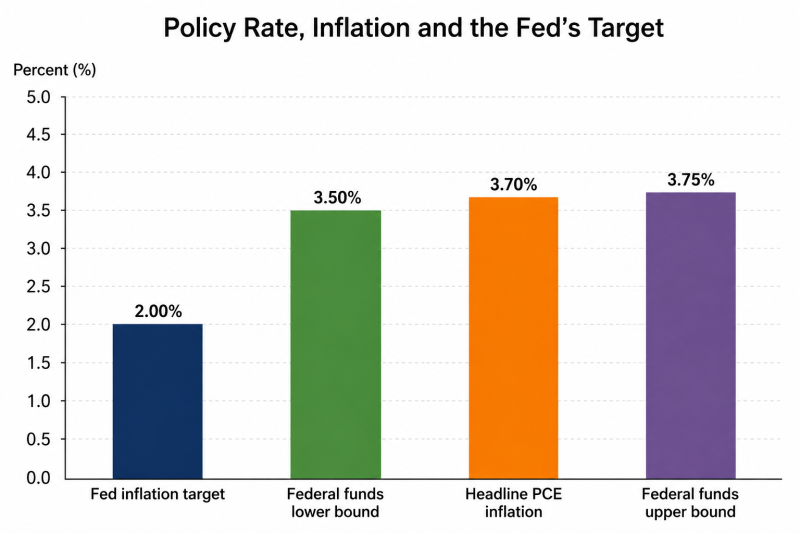
The comparison also exposes a weakness in the argument. Using headline PCE, the upper bound of the federal funds rate is only 0.05 percentage points above inflation. Monetary policy does not look highly restrictive in real terms.
Williams’ case depends on inflation falling while the nominal rate remains unchanged. As inflation declines, the real policy rate rises automatically.
| Inflation scenario | Fed funds upper bound | Approximate real rate |
| 3.70% | 3.75% | 0.05% |
| 3.00% | 3.75% | 0.75% |
| 2.50% | 3.75% | 1.25% |
| 2.00% | 3.75% | 1.75% |
Holding rates steady can therefore tighten financial conditions without another FOMC increase — but only if inflation continues to slow.
The Hold Comes With a Clear Condition
Williams did not rule out further tightening.
If the economy is not on a trajectory that will bring inflation back down to 2%…it would absolutely be appropriate to act.
The decision now depends less on the latest headline number than on the next sequence of core inflation readings.
In Williams’ base case, tariff effects weaken, energy prices stabilize and growth remains near trend. The Fed holds rates while inflation gradually declines. The alternative is straightforward: if core inflation stalls or energy costs spread into wages and services, rates go higher.
Williams said he is focused on whether the next several months of core inflation are consistent with a sustained return to 2%.
The Fed Is Treating the Oil Shock as Temporary
The Middle East conflict has pushed up oil, fuel and transportation costs. Brent crude recently traded above $90 per barrel, while U.S. gasoline prices moved above $4 per gallon. Williams does not expect those increases to produce persistent inflation.
I don’t anticipate…that we’re going to see continued inflationary push in the second half of the year or the next year from the conflict in the Middle East.
That view assumes energy prices stabilize before higher costs spread through the economy. The Fed would become more concerned if the shock moved beyond fuel prices into freight, food, wages, rents, services or inflation expectations.
A brief rise in oil changes headline inflation. A prolonged rise changes business costs and wage demands. Williams acknowledged that the outlook remains dependent on geopolitical developments.
Tariffs May Have Raised Prices Without Permanently Raising Inflation
Williams believes most of the effect from existing tariffs has already entered consumer prices. A tariff can lift the price level once without creating permanently higher inflation. Persistent inflation requires businesses to continue raising prices at an elevated rate. His forecast assumes no major tariff escalation and limited second-round effects. Lower housing inflation and weaker goods inflation could then offset remaining tariff pressure and pull the broader PCE index lower.
Market Pricing Is Not Fed Guidance
Investors have continued to price a meaningful probability of another rate increase before the end of 2026. Treasury yields have also risen as markets reassess how long inflation may remain above target.
Williams said financial markets matter because they affect borrowing costs, investment and household demand. He rejected the idea that the Fed must deliver the path already priced by traders.
Asked whether policymakers needed to validate market expectations, he answered:
Absolutely not.
He added:
We always have to come, do our own analysis, do our hard work, assess all of the factors influencing the economy [and] the outlook.
The Fed treats market pricing as information, not a commitment. That leaves future FOMC decisions less predictable. Williams sees no need to remove that uncertainty through stronger forward guidance.
AI Spending Is Inflationary at the Margin, Not a Systemic Threat
The AI investment cycle is increasing demand for semiconductors, servers, data centers, networking equipment, electricity and skilled labor. Williams said that spending is already affecting some prices.
It’s not a big driver of inflation right now, but is clearly something that we’re seeing.
The short-term impact is inflationary. Data-center construction competes for equipment, power, land and workers in sectors where supply is already tight.
The longer-term impact could move in the opposite direction. If AI raises productivity, companies may produce more with the same amount of labor and capital, reducing unit costs.
Near-term channel
AI capital spending:
→ chip and server demand
→ data-center construction
→ higher electricity consumption
→ grid and cooling investment
→ pressure on equipment, power and labor costs
Long-term channel
AI adoption:
→ higher productivity
→ greater productive capacity
→ lower unit costs
→ weaker structural inflation pressure
Williams does not see the AI boom as an immediate financial-stability risk.
Most of these businesses have very high earnings, so I’m not as worried about the financial stability from the leverage right now.
The distinction is leverage. AI projects may be overpriced or produce weak returns, but the largest investors are financing them from substantial earnings and cash flow rather than depending entirely on fragile borrowing structures.
That reduces the risk of an AI downturn spreading through the banking system in the same way the housing collapse did in 2008.

The Data That Could Break Williams’ Forecast
The current policy stance depends on four conditions:
| Indicator | Latest reading or condition | What supports a continued hold |
| Headline PCE | 3.7% | YoYContinued decline |
| Core PCE | 3.3% YoY | Several softer monthly readings |
| Federal funds rate | 3.50%–3.75% | Rising real rate as inflation falls |
| GDP growth | About 2% | No renewed overheating |
| Brent crude | Recently above $90 | Stabilization or decline |
| AI investment | Rapid expansion | Limited spillover into broad inflation |
Core PCE is the decisive variable. Falling energy prices may lower headline inflation, but the Fed needs evidence that underlying services and goods inflation are also weakening.
Oil is the second major risk. A temporary spike fits Williams’ forecast. A sustained increase above $90 would be harder to dismiss. Labor-market data will determine whether domestic demand is reinforcing inflation. Renewed wage acceleration would weaken the argument that current price pressure is mainly supply-driven.
A Hold, Not an Easing Signal
Williams is arguing that the Fed can wait, not that it can cut. The federal funds rate remains at 3.50%–3.75%, headline PCE inflation is 3.7%, core PCE is 3.3%, and a sustained return to 2% may not arrive until 2028. The hold rests on a specific forecast: tariff pressure fades, oil stabilizes and underlying inflation resumes its decline.
If that forecast fails, Williams has already defined the response. The Fed should raise rates again.
 Marina Lubimova