Artem Voloskovets

In the last twenty years, people globally have seen their incomes increase at a faster rate but the difference in wealth between the most productive economies and other developed nations remains large. Data that compares what people can buy with their money shows that many countries are becoming more equal but some stay much wealthier than others.
For the year 2000, individuals in advanced economies had an average income of about $29 800. In Liechtenstein, people had an average income of approximately $92 100, which was more than three times higher at that time.
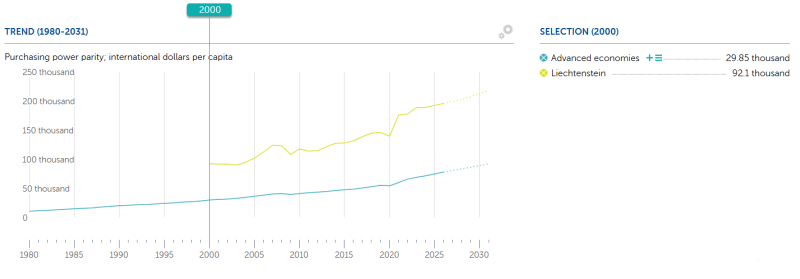
By the year 2030 economists expect that both figures will be much higher. Advanced economies are likely to reach about $88 800 and the income in Liechtenstein could rise to around $212 400. And while both groups grow at a rate that is similar, the total amount of money that separates them is getting larger.
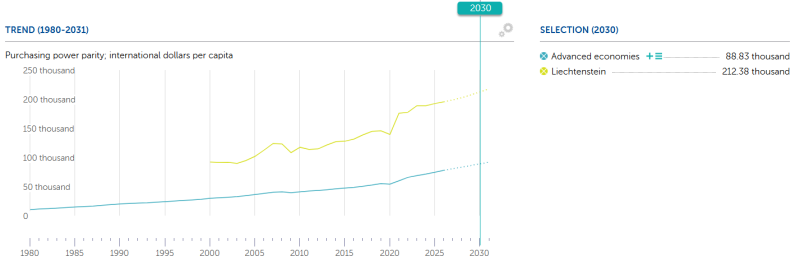
The gap increases from about $62 000 in the year 2000 to more than $120 000 by the year 2030. It is clear that economies at the highest level continue to grow faster than other developed markets.
This is because certain economies like Liechtenstein have specific features, like a financial sector that holds many assets, large amounts of money coming in from other countries and a low number of residents. Due to those factors, the income per person appears larger in the data.
With the steady increase in advanced economies, it is evident that workers are more productive and technology is improving as the economy expands over time. On the chart the faster growth after 2020 shows that the cycle of recovery is strong.
But the data shows two different situations occurring right away. To be sure income levels are rising for many people but the wealthiest countries are still moving further ahead. If advanced economies become more similar to each other, the distance between them and the highest income countries still exists and continues to grow.
 Artem Voloskovets