Artem Voloskovets
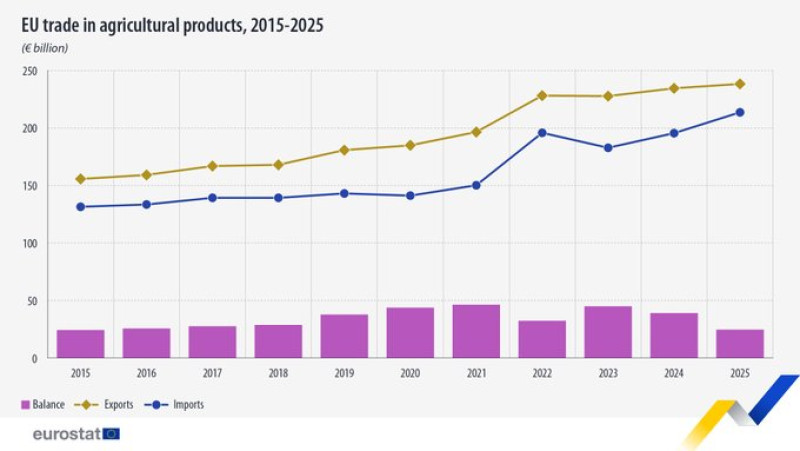
European Union agricultural exports climbed to nearly €240 billion in 2025, reaching a new decade high and reinforcing the narrative that Europe’s food sector remains globally dominant. But beneath the headline growth, the latest Eurostat data may actually signal a structural vulnerability developing inside the EU economy.
At first glance, the numbers look strong. Exports of agricultural products have steadily risen from roughly €155 billion in 2015 to almost €240 billion in 2025. The EU also maintained a positive trade balance throughout the entire period, suggesting continued competitiveness across global food markets.
Yet imports are rising even faster.
EU agricultural imports surged from around €130 billion in 2015 to more than €210 billion in 2025, nearly erasing much of the bloc’s export advantage. The trade surplus, which peaked around 2021, has narrowed sharply in recent years despite record export values.
That divergence is becoming increasingly difficult to ignore.
The trend suggests Europe may be growing more dependent on external suppliers for key agricultural inputs and food products even as export revenues rise. Higher import growth can reflect inflation, supply-chain fragmentation, climate-related production stress, and weakening domestic self-sufficiency across parts of the agricultural sector.
The most revealing detail in the chart is not the export growth itself, but the shrinking balance bar in 2025. While headline exports reached another record, the surplus dropped back toward levels last seen nearly a decade ago.
For markets, this creates a contrarian signal.
Many investors continue to view European agriculture as a straightforward beneficiary of global food inflation and supply shortages. But if imports continue catching up to exports, margins across the sector could face increasing pressure from rising input costs, logistics exposure, and geopolitical trade risks.
The data may also complicate Europe’s long-term strategic ambitions. Brussels has repeatedly emphasized food security, supply-chain resilience, and reduced external dependence. However, the latest figures imply the opposite dynamic could already be unfolding beneath the surface of record export headlines.
In other words, Europe’s agricultural trade numbers still look strong - but the direction of the balance tells a far more cautious story.
 Artem Voloskovets