Admin
Admin

U.S. mortgage activity weakened further last week as borrowing costs climbed back toward 7%, according to new data from the Mortgage Bankers Association. Applications for home loans fell 4.1%, dropping to their lowest level since May 2025, as both prospective buyers and homeowners looking to refinance pulled back sharply in the face of rising rates.
Applications slide as rates climb
The MBA's weekly survey showed refinancing applications plunging 8.8%, a steep decline that underscores how sensitive homeowners remain to even modest moves in borrowing costs. Purchase applications also softened, contributing to the overall 4.1% drop and pushing total mortgage activity to its weakest point in more than a year.
The interest rate for 30-year conforming mortgages increased to 6.97%. The interest rate for jumbo loans, which lenders provide when a loan amount exceeds the limits of a conforming loan, rose to 7.03%. Both percentages are part of an ongoing increase in the cost of borrowing money throughout the current year. Because of those higher costs, home purchasers have less money available for monthly payments while they also pay high prices for houses.
A longer view of the mortgage cycle
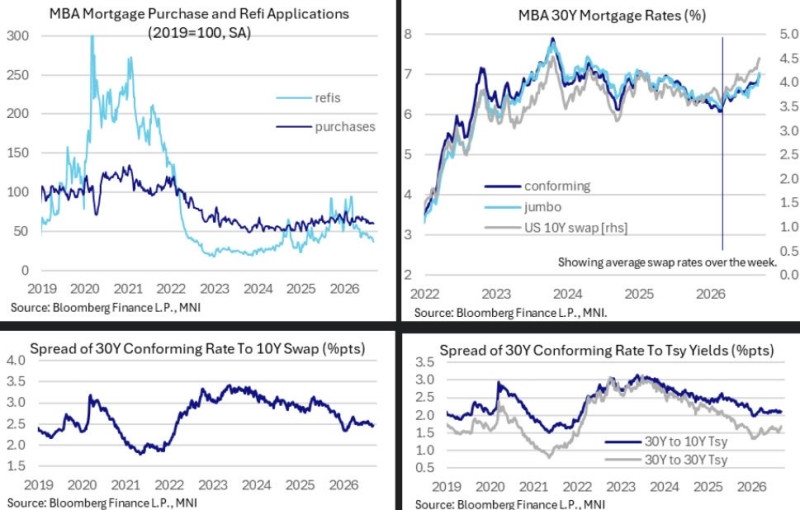
Charted against history, the current pullback looks stark. MBA data going back to 2019 shows refinancing applications, indexed to 100 in 2019, spiking above 250 during the low-rate period of 2020 and 2021 before collapsing to levels well below 100 in recent years. Purchase applications have followed a similarly weak path, hovering near multi-year lows through 2025 and into 2026.
Mortgage rates themselves tell a parallel story. Conforming and jumbo 30-year rates surged from roughly 3% in 2022 to nearly 8% by late 2023, before easing modestly and now turning higher again, with both rates converging near 7% alongside a rising 10-year swap rate. The spread between the 30-year conforming rate and the 10-year swap has held in a range between roughly 2% and 3%, while the spread to Treasury yields has narrowed somewhat but remains historically elevated, suggesting mortgage costs are being driven both by broader rate moves and by persistent spread dynamics in the mortgage market.
What it means for housing and lenders
For prospective homebuyers, rates near 7% translate directly into higher monthly payments and reduced purchasing power, a dynamic likely to keep dampening transaction volumes in the housing market. For existing homeowners, the sharp drop in refinancing applications signals that the incentive to refinance has largely evaporated for those who locked in lower rates in prior years.
The trend also carries implications for mortgage lenders and servicers, who face shrinking origination volumes and thinner refinancing pipelines as long as rates hold near current levels. With market rates still climbing, the pressure on housing demand and refinancing activity described in the report could deepen further, leaving the sector watching closely for any signs of relief in the broader rate environment.
 Admin
Admin