Marina Lubimova

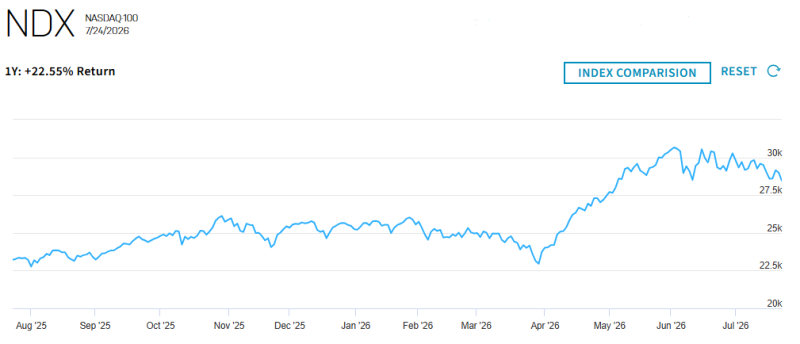
The index remains up 22.55% over the past year. Investors have not rejected artificial intelligence or lost confidence in long-term demand for computing power. They are reassessing how much capital the AI buildout will require and how quickly that money can produce an acceptable return.
That is a harder question for Microsoft, Alphabet, Amazon and Meta than it is for the companies selling them chips, memory, networking equipment and power infrastructure.
Insert the provided Nasdaq 100 chart here.
The decline follows a steep repricing
The Nasdaq 100 spent much of late 2025 and early 2026 moving within a relatively narrow range. It then accelerated sharply from April, climbed above 30,000 in June and remained close to record territory before the latest retreat.
The sequence matters. A 1.3% decline after a 22.55% annual gain is not evidence that the AI trade has collapsed. It shows that investors are reducing risk after a rally that priced in years of strong demand, expanding margins and successful AI monetization.
That leaves less room for disappointment. A company can report rising cloud revenue and strong AI demand, yet still fall if its spending grows faster than investors expected.
The market is no longer rewarding AI exposure by default. It is testing the assumptions behind the valuation.
AI now consumes physical capital
The first phase of the AI rally treated higher investment as evidence of future growth. More GPUs, larger models and new data centers supported higher valuations across the technology sector.
The spending now extends far beyond accelerators. AI systems require high-bandwidth memory, advanced networking, storage, cooling equipment, land, construction and large amounts of electricity. Each expansion in training or inference capacity demands additional physical infrastructure.
This makes the current cycle different from the traditional software model. Software can often add users at low marginal cost. AI services remain tied to servers, energy and continuous infrastructure investment.
Bond yields raised the required return
The Treasury market added pressure to that calculation.
Insert the provided Treasury yield table here.
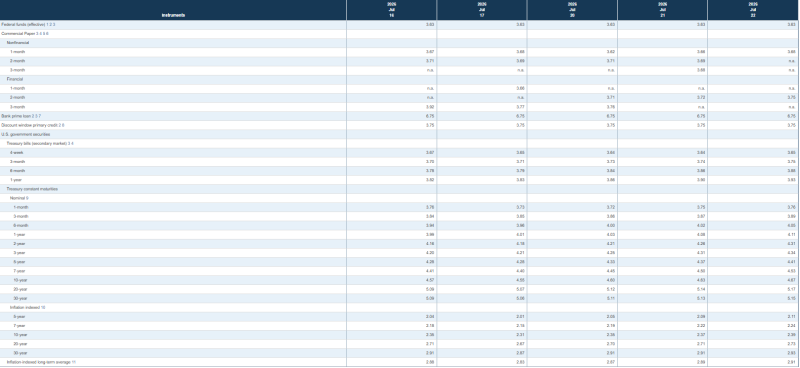
Between July 16 and July 22, yields rose across most of the curve:
- The 2-year yield increased from 4.16% to 4.31%.
- The 5-year yield moved from 4.28% to 4.41%.
- The 10-year yield climbed from 4.57% to 4.67%.
- The 30-year yield rose from 5.09% to 5.16%.
The effective federal funds rate remained at 3.63%, but longer-term borrowing costs moved higher. The 10-year yield gained 10 basis points, while the 2-year yield rose 15 basis points over the period shown.
Higher yields reduce the present value of earnings expected far into the future. They also increase the return investors demand from expensive, capital-intensive projects.
That is especially relevant to AI. The technology may generate enormous economic value, but the infrastructure must be financed and built before much of that value appears in reported earnings.
The problem is not weaker AI demand. It is a higher hurdle rate for funding that demand.
The buyers and sellers of AI infrastructure have different economics
The largest cloud and internet companies carry the cost of expanding AI capacity. Their suppliers recognize the revenue much earlier.
A hyperscaler that orders more accelerators increases capital expenditure immediately. The chipmaker records a sale. Memory producers, networking vendors, cooling specialists and electrical-equipment companies receive additional demand. The customer then has to deploy the equipment, attract workloads and recover the investment over several years.
This creates an asymmetry inside the AI trade.
Infrastructure suppliers benefit directly from rising orders. Platform companies must prove that the infrastructure can support enough cloud usage, subscriptions, advertising revenue or productivity gains to justify the cost.
Both groups may benefit from AI adoption, but their cash-flow timing is different. One sells the buildout. The other finances it and waits for monetization.
Capex has become part of the valuation debate
Revenue growth and operating margins are no longer enough to assess the largest technology companies. Investors are also tracking:
- capital expenditure growth;
- depreciation from new infrastructure;
- free cash flow after investment;
- data-center utilization;
- identifiable revenue from AI products.
A higher spending forecast can now outweigh otherwise strong operating results. It signals that maintaining AI leadership may require more cash, more power and more construction than previously assumed.
The central issue is not whether these companies can afford the investment. Most have large cash balances and highly profitable core businesses. The issue is whether incremental AI spending will earn returns above the rising cost of capital.
The AI trade is splitting into separate businesses
The first stage of the rally grouped chipmakers, cloud providers, software companies and data-center operators under one label. The next stage is separating them according to their economics.
Chip and networking suppliers are judged on orders, capacity and margins. Cloud companies are judged on utilization and revenue growth. Software vendors must show that AI features can raise prices or improve retention. Corporate users must demonstrate measurable productivity gains.
These businesses do not capture value at the same speed.
That is why a decline in the Nasdaq 100 can coexist with strong demand for AI hardware. The market may remain optimistic about the technology while becoming less optimistic about the price paid for certain stocks or the returns expected from their investment programs.
The Nasdaq’s 1.3% fall does not invalidate the AI cycle. It marks a stricter phase of it.
After a 22.55% annual gain and a sharp rally from April, investors are no longer paying simply for participation. They want to see which companies can turn infrastructure spending into durable free cash flow—and which are primarily transferring capital to their suppliers.
 Marina Lubimova