Marina Lubimova
Prices have fallen dramatically from February's peak near $118 per ounce. Yet they continue to trade almost twice as high as they were a year ago. The explanation is increasingly found in the physical market rather than in speculative enthusiasm.
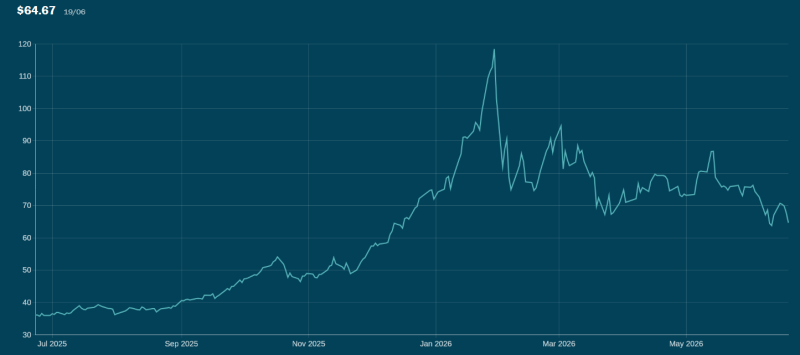
- July 2025: ~$36/oz
- January 2026: ~$75/oz
- February 2026 peak: ~$118/oz
- June 2026: ~$67/oz
The collapse from $118 to the mid-$60s removed much of the excess that accumulated during the rally. What it did not remove was the imbalance that helped create the rally in the first place.
The Speculators Left. The Deficit Stayed.
Most commodity booms end when prices become high enough to restore balance between supply and demand. Silver has not reached that point. Industry forecasts suggest global supply will total roughly 1.07 billion ounces in 2026. Demand is expected to exceed 1.11 billion ounces. That leaves a shortfall of approximately 46 million ounces.
| 2026 Forecast | Million ounces |
| Supply | 1,066 |
| Demand | 1,113 |
| Deficit | -46 |
This is not a one-off anomaly. The market has spent much of the decade consuming more silver than it produces. Inventories can absorb that gap for a time, but they cannot eliminate it. The striking part is that the deficit persists despite prices that remain historically elevated.
Demand Is No Longer Just An Investment Story
Silver was discussed primarily as gold's more volatile cousin. That description is becoming less accurate. Industrial demand now accounts for the majority of global consumption. Electronics, power infrastructure, solar installations, data centers and advanced manufacturing all require silver's conductivity and durability.
According to industry projections, industrial demand alone will approach 640 million ounces in 2026. Unlike investment demand, which can disappear quickly, industrial demand tends to be tied to long-term capital spending cycles. That makes the market less sensitive to short-term swings in investor sentiment.
The Market Is Searching For A New Equilibrium
The past month illustrates the shift underway. Silver slid from above $75 to nearly $63 before recovering toward $67.
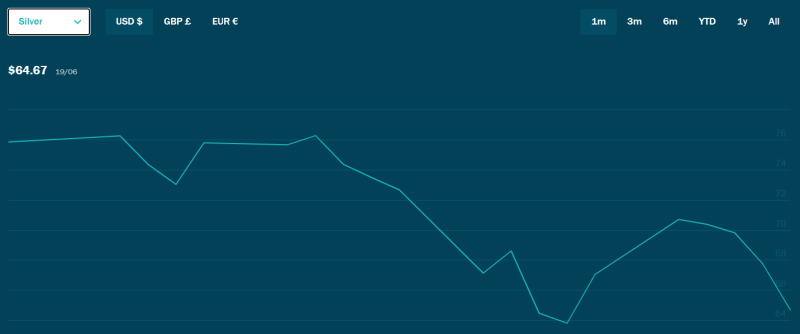
Rather than signalling a new speculative surge, the move looks more like a search for equilibrium. Buyers appear willing to step in near the mid-$60 range, even after one of the steepest corrections in the commodity complex.
That behaviour would be difficult to explain if the market were purely driven by momentum traders. It becomes easier to understand when viewed against a backdrop of recurring physical shortages.
A Correction Solved One Problem, Not The Other
The silver market entered 2026 with two distinct forces pushing prices higher. One was speculation. The other was scarcity. The first has largely been unwound. A 43% decline from the peak made sure of that. The second remains unresolved.
Until mine supply grows meaningfully faster than demand, or industrial consumption slows substantially, the market is likely to remain tighter than current prices suggest.
A 3% rally is not the story. The story is that after losing nearly half its value in four months, silver is still trading near $67 an ounce while the world continues to consume more metal than it produces.
 Marina Lubimova