Artem Voloskovets

The proposal values the airline far above where its shares traded before takeover speculation emerged. For a business operating in one of the most cyclical industries, that raises an obvious question: why is Apollo willing to pay such a premium?
The answer is likely to extend well beyond aircraft and ticket sales.
A Deal Priced Well Above the Market
Apollo's £7.15-per-share proposal exceeds Castlelake's competing £6.90 offer by roughly 3.6%.
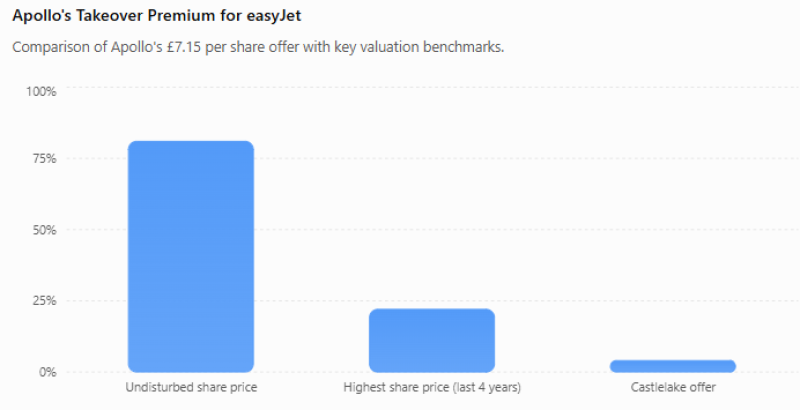
Relative to easyJet's previous valuation, the premium is considerably larger:
- 81% above the unaffected share price;
- 22% above the highest share price recorded during the previous four years;
- 3.6% above Castlelake's competing proposal.
Premiums of this magnitude are uncommon in the airline sector, where earnings remain heavily exposed to fuel prices, labor costs and economic cycles. Apollo is therefore paying for assets whose value is unlikely to be reflected in a single year's profits.
Airport Slots Are the Scarce Asset
Aircraft can be leased. Airport slots cannot. EasyJet controls thousands of takeoff and landing slots at some of Europe's busiest airports, including London Gatwick, Amsterdam Schiphol, Geneva, Milan Malpensa and Paris Charles de Gaulle. Most operate under capacity constraints, making additional slots increasingly difficult to obtain.
Those positions resemble infrastructure assets more than transportation equipment. As passenger demand grows and airport expansion remains limited, existing slot portfolios become increasingly valuable.
Beyond Low-Cost Flying
EasyJet today generates revenue from more than airline tickets.
Its business includes baggage fees, seat selection, onboard sales, travel partnerships and, increasingly, easyJet holidays — a package-holiday business that captures spending on hotels and other travel services alongside flights.
These activities typically produce higher margins than base fares and offer more opportunities to increase revenue per customer without adding capacity.
That gives Apollo multiple levers for value creation beyond simply filling more seats.
Why Private Equity Sees Opportunity
The airline industry has rarely been a preferred destination for private equity. High capital requirements and volatile earnings have historically limited investor interest.
Apollo appears to be taking a different view. Rather than betting on near-term passenger growth, the firm is acquiring an established network with constrained airport access, direct customer relationships and multiple ancillary revenue streams.
Private ownership also gives management greater flexibility to pursue operational improvements without the quarterly performance pressure of public markets.
Timing Favors Long-Term Buyers
The bid comes as European aviation continues to face elevated fuel prices and uneven consumer demand.
Such conditions often weigh on public valuations even when the long-term strategic value of an asset remains intact.
If industry conditions normalize over the next several years, Apollo would own the same airport positions, customer base and route network acquired during a period of depressed market sentiment.
A Short Bidding War Added Hundreds of Millions
Castlelake initially offered £6.90 per share, but Apollo increased the bid to £7.15, prompting the easyJet board to support the higher proposal.
The difference amounts to only 25 pence per share, yet across the company's outstanding shares it translates into hundreds of millions of pounds of additional value for shareholders.
It also suggests that more than one institutional investor viewed easyJet as materially undervalued.
More Platform Than Airline
EasyJet combines several assets that are difficult to replicate:
- airport slots at constrained hubs;
- an established European route network;
- a recognized consumer brand;
- direct digital distribution;
- a growing holiday business;
- millions of active customers.
Viewed together, those assets resemble a travel platform rather than a traditional airline. That distinction helps explain why Apollo was willing to pay an 81% premium.
The Broader Signal
The transaction highlights a recurring disconnect between public and private markets.
Public investors tend to value airlines based on near-term earnings, which fluctuate with fuel costs and travel demand. Private buyers can instead value assets that become more valuable over decades — airport access, customer relationships and distribution networks.
Apollo's offer suggests it believes easyJet's strategic position is worth considerably more than its recent market capitalization implied.
The acquisition is less a bet on next year's passenger traffic than on long-term control of scarce aviation infrastructure across Europe.
 Artem Voloskovets