Peter Smith
AI coding startup Cursor has reportedly reached a staggering $2.7 billion annualized revenue run rate, but the milestone comes with a major caveat: the company was operating at negative gross margins as recently as early 2026.
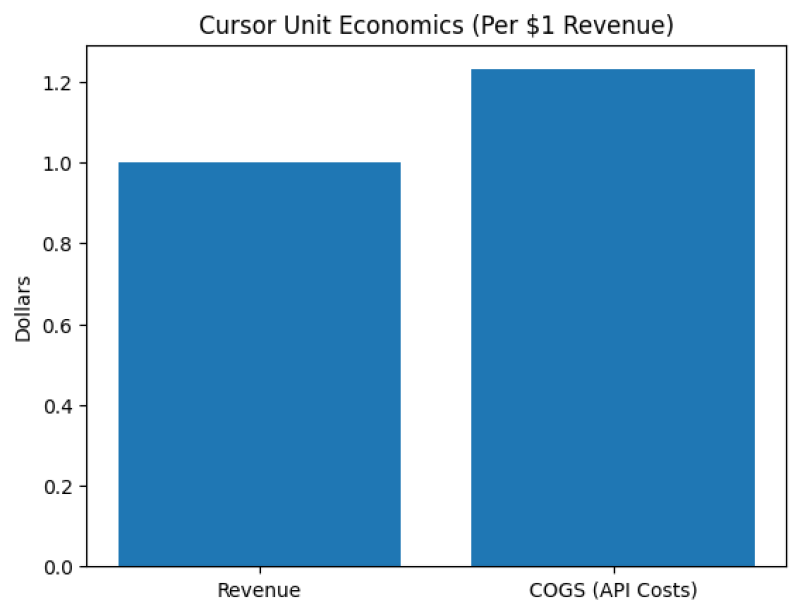
In the quarter ending January, Cursor’s gross margin stood at -23%, meaning the company spent roughly $1.23 on API costs for every $1 of revenue, largely due to payments to OpenAI and Anthropic.
Unit Economics Breakdown
The chart below highlights the core issue behind Cursor’s business model:
- revenue per unit is lower than cost
- API dependency drives negative margins
At scale, the imbalance becomes even more striking. With a $2.7B ARR, the implied cost structure suggests billions in annual compute expenses:
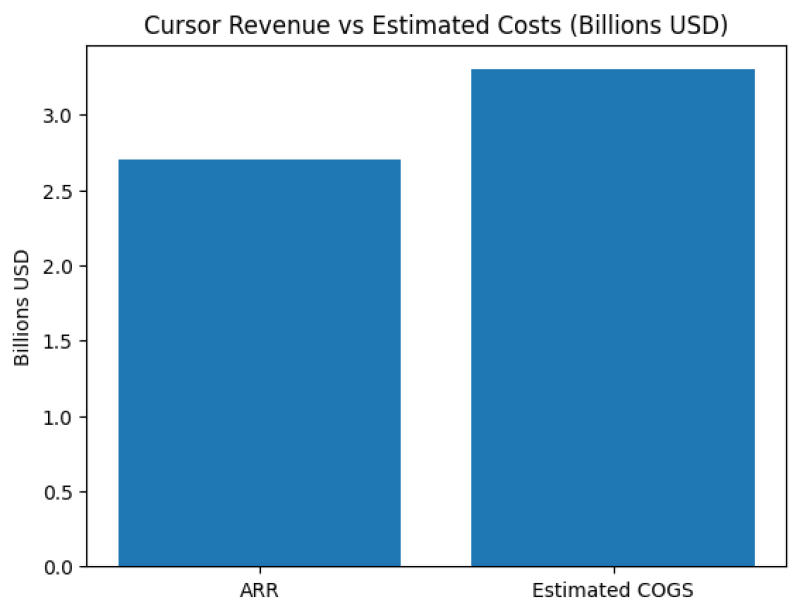
This highlights the fundamental challenge: rapid growth is being driven by infrastructure that the company does not control.
SpaceX Deal Changes Everything
The situation shifted dramatically following a deal with SpaceX.
- option to acquire Cursor at $60B valuation
- or pay $10B collaboration fee
- replaces a planned $2B raise at $50B valuation
From Cursor’s perspective, this is a massive upgrade:
- more capital
- no dilution
- higher implied valuation floor
Strategic Angle
For Elon Musk, the reasoning is based on specific needs - if xAI needs more users, Cursor provides access to developers who pay for services. Since SpaceX owns the Colossus cluster, it has a large amount of computing power.
By making this deal, the companies connect the people who want the service at Cursor with the models at xAI and the hardware at SpaceX.
Turning Point: From API Dependence to Ownership
At this time Cursor is changing its plan so it does not depend solely on external interfaces. It released a model that it owns called Composer and started using a system that chooses between different models. Because of the changes, the margins are positive as of March.
With the support of SpaceX, it is possible for the company to act in new ways. It can lower its payments to OpenAI or Anthropic. It is able to train its own models and make the profit for each unit better.
In the AI market, there is a conflict between fast growth in revenue and costs that are too high to maintain. The agreement with SpaceX is a moment of change. It moves Cursor from a tool with high growth and negative margins to a platform that owns its entire supply chain. If the company succeeds, it provides a method for other AI firms to avoid high external costs and keep value over a long period “API trap”.
 Peter Smith