Alex Dudov
The latest data shared by Tesla community trackers shows a sharp recovery in quarterly export momentum during 2026, with first-month export volumes climbing above 50,000 vehicles and total quarterly export pace approaching levels not seen since Tesla’s strongest post-pandemic periods.
The trend is drawing attention because Giga Shanghai remains one of Tesla’s most strategically important factories globally, serving not only China but also large portions of Europe and Asia-Pacific markets.
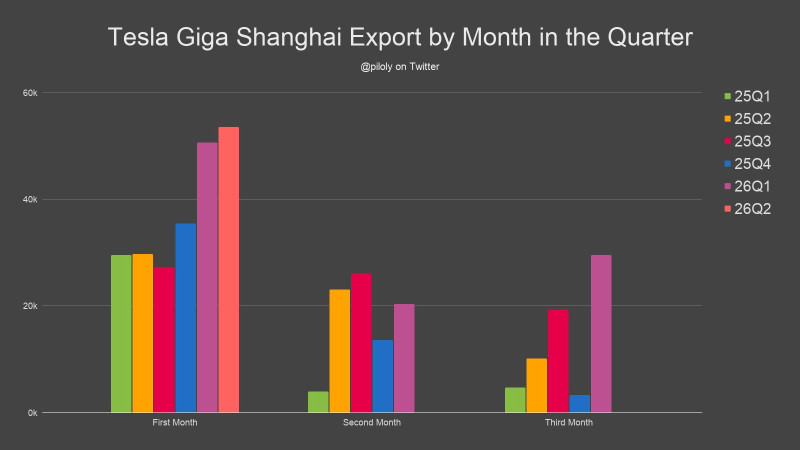
The Export Pattern Is Starting to Change
Historically, Tesla’s Shanghai export schedule followed a predictable quarterly rhythm:
- heavy exports early in the quarter,
- stronger domestic China deliveries later,
- and softer third-month international shipments.
But the new charts suggest the structure may be shifting again.
The first month of 26Q2 shows exports climbing above 53,000 vehicles, while second- and third-month export activity also remains elevated relative to previous years. That matters because stronger distribution across all three months could indicate:
- improved production stability,
- better logistics coordination,
- and healthier international demand conditions.
For Tesla watchers, the biggest signal is not just the size of exports — it is the consistency.
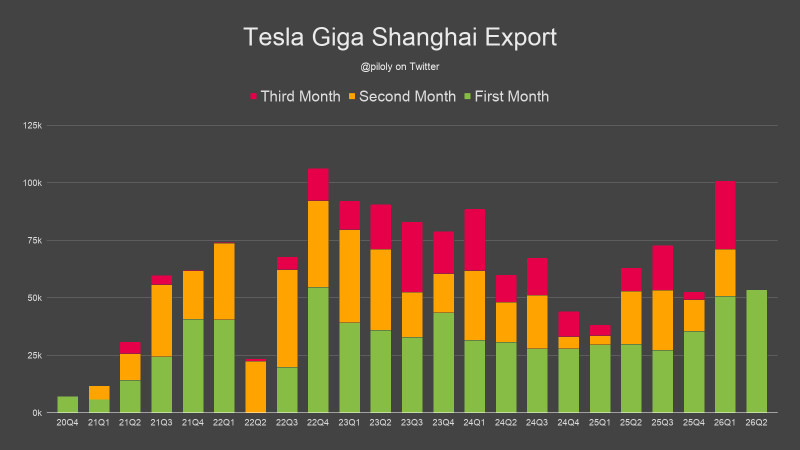
Why Investors Are Watching Shanghai Closely
Giga Shanghai has become one of Tesla’s most important operational indicators. The factory is often viewed as a real-time demand proxy for:
- Europe,
- Southeast Asia,
- Australia,
- and other key export regions.
When Shanghai exports accelerate, markets frequently interpret it as a sign of improving global delivery momentum. That is especially important now because Tesla has spent much of the last year facing:
- aggressive EV competition in China,
- pricing pressure,
- weaker European EV demand,
- and investor concerns about slowing growth.
A sustained rebound in exports could help shift that narrative.
What’s Next for Tesla?
The next major question is whether Tesla can convert rising Shanghai exports into stronger global delivery numbers during the second half of 2026.
Several scenarios are now emerging:
1. Bullish Scenario
If export momentum continues rising through 26Q3, analysts could begin revising delivery expectations upward again, particularly if Europe stabilizes and new incentive programs support EV demand. Higher Shanghai utilization would also improve manufacturing efficiency and potentially support margins after multiple years of price cuts.
2. Neutral Scenario
Tesla may simply be normalizing production after weaker periods in 2024–2025, without necessarily entering a new hypergrowth cycle. In that case, exports remain healthy but volatile quarter to quarter.
3. Bearish Scenario
If global EV demand weakens again or trade tensions intensify, elevated export production could eventually create inventory pressure rather than stronger deliveries. That risk remains particularly relevant in Europe and China’s increasingly competitive EV market.
The Bigger Trend
Regardless of short-term fluctuations, the charts suggest one important thing:
Tesla’s Shanghai factory is regaining momentum after a difficult stretch.
And because Shanghai remains central to Tesla’s global delivery machine, investors are increasingly treating these export numbers as an early indicator of where the company’s broader growth story could head next.
 Alex Dudov