Peter Smith
Elon Musk’s long-disputed Tesla compensation package is back at the center of attention - and this time it is already reshaping the company’s ownership structure. The development comes as investors increasingly focus on Tesla stock outlook and long-term growth narrative, particularly as the company pivots toward AI, robotics, and autonomy beyond its core EV business.
What happened
Following a legal reversal in Delaware, Tesla has registered 304 million shares linked to Musk’s 2018 CEO compensation plan. The options, priced at $23.34, must be exercised within a defined window between late May and mid-August, implying a total cost of roughly $7.1 billion.
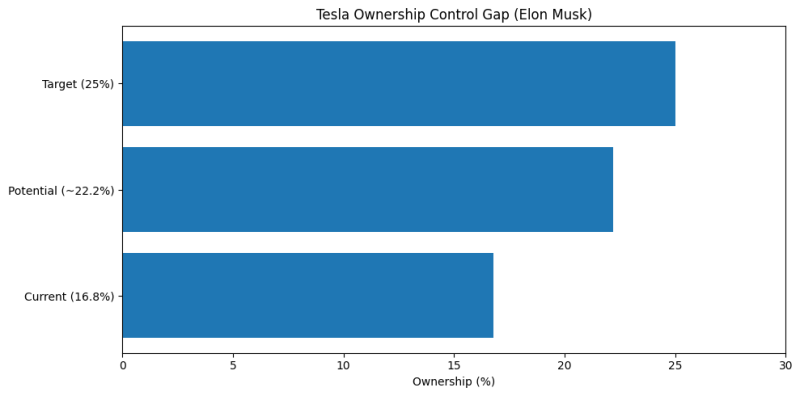
As Musk begins to act on these options, his ownership stake is set to rise to approximately 16.8%. While significant in absolute terms, the increase still leaves him well below the level he has publicly identified as necessary to secure long-term strategic control.
A legal battle turned governance story
This development cannot be understood without the legal context behind it. The 2018 compensation package was challenged in Delaware courts and at one point struck down, triggering a broader debate about executive pay and board oversight. Its later reinstatement by a higher court in 2025 not only revived the package but also underscored growing tensions between shareholders, courts, and corporate leadership.
In that sense, what might look like a compensation event is in reality part of a larger discussion about corporate governance and founder control in tech companies.
The real issue: control, not compensation
At the center of the story is Musk’s repeated claim that he needs around 25% ownership in Tesla to maintain sufficient influence over its direction. Even after the latest increase, he remains far from that threshold.
This gap is not just symbolic. For a company that is increasingly betting on long-term, capital-intensive initiatives like robotaxis and humanoid robots, control over strategic decisions can be as important as capital itself. Without a larger stake, Musk could, in theory, face pressure from shareholders whose priorities differ from his own.
Why reaching 25% is difficult
Even future compensation plans may not fully close the gap. A separate package approved by shareholders in 2025 could grant hundreds of millions of additional shares, yet even that would only bring Musk’s ownership to roughly 22% on a pre-tax basis.
At the same time, structural constraints remain. A previously discussed interim award was canceled to avoid overlapping benefits, and potential tax obligations - which could consume a substantial portion of shares if settled in equity - further limit the net increase in ownership.
The bigger bet behind the numbers
What makes the situation more striking is the scale of the long-term targets tied to Musk’s compensation. The framework is built around extremely ambitious milestones, including a multi-trillion-dollar market capitalization and massive expansion in both vehicles and next-generation technologies.
These targets effectively link Musk’s personal upside not just to Tesla’s growth, but to its transformation into a broader AI and robotics company.
Market implications
For investors, the implications go beyond ownership percentages. A higher insider stake is often interpreted as a sign of alignment with shareholders, yet it also raises concerns about dilution and governance balance.
More importantly, the situation highlights a key uncertainty: whether Tesla’s strategic direction will ultimately be shaped by a single dominant vision or by a broader shareholder base. That question is becoming increasingly relevant as the company moves into more speculative, long-horizon sectors.
 Peter Smith