Artem Voloskovets

Adjusted earnings were $3.65 per share, versus the $3.33 estimate. Revenue reached $4.05 billion, exceeding expectations by $150 million.
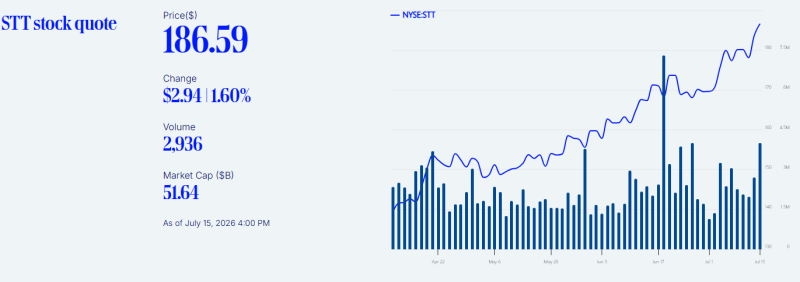
The first chart shows a largely uninterrupted advance through the quarter. The stock moved above $150 in late April, approached $160 by early June and accelerated past $170 in the second half of June. By July 15, it had reached $186.59.
Trading volume also increased during several stages of the rally, particularly around the sharp moves in late April, early June, mid-June and mid-July. The pattern suggests that investors had been raising their expectations before the earnings release rather than waiting for the quarterly figures.
That makes the breadth of the beat more relevant than the headline EPS surprise.
Net interest income was $860 million, compared with the $837.1 million estimate. The fully taxable-equivalent net interest margin reached 1.1%, slightly above the expected 1.0%. State Street therefore generated more interest income than analysts anticipated without requiring a large margin surprise.
Assets under management provided the clearest forward-looking signal. AUM reached $6.28 trillion, $130 billion above the $6.15 trillion consensus estimate. That difference expands the asset base from which State Street can collect management and servicing fees.
The figure does not show how much of the increase came from net inflows and how much came from rising market values. Even so, the higher total reduces State Street’s dependence on interest income alone. That distinction matters if lower rates eventually put pressure on net interest income.
The market response was positive but measured. State Street shares spent much of July 15 moving between approximately $184.60 and $185.80 before strengthening late in the session.
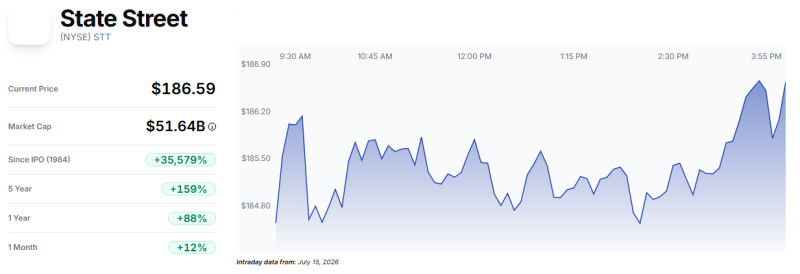
The stock closed at $186.59, up $2.94, or 1.6%, near the upper end of the day’s range. The chart shows the strongest buying during the final part of the session, when the shares moved toward an intraday high near $186.70.
The reaction is notable because the stock had already gained 12% over the previous month and 88% over the past year. A strong report could easily have triggered profit-taking after that run. Instead, the shares closed higher, leaving State Street with a market capitalization of approximately $51.64 billion.
The results support the recent revaluation, but they also raise the standard for the next quarter. At $186.59, investors are no longer pricing State Street as a company waiting for a recovery. They are pricing continued growth in assets, fees and earnings.
The main risk is that part of the current strength depends on conditions outside the company’s control. Higher asset prices can lift AUM without generating equivalent organic inflows, while lower interest rates could reduce the contribution from net interest income. Without the detailed quarterly presentation, it is not yet possible to separate market appreciation from new client assets.
Still, the Q2 figures show that State Street exceeded forecasts across several independent measures rather than relying on one unusually strong line item. The stock’s late-session rise suggests the report was strong enough to support an already demanding valuation, even if it did not produce a dramatic post-earnings jump.
 Artem Voloskovets