Marina Lubimova

Gold has recently failed to respond as strongly as expected during a geopolitical shock, with price action appearing subdued despite conditions that would typically support upside. Fidelity's director of global macro Jurrien Timmer, writing on X, notes that gold and Treasuries appear to be acting as sources of liquidity rather than pure safe-haven assets - contributing to the unusual softness in recent price action.
When Gold's Safe-Haven Behavior Breaks Pattern
The chart highlights gold holding at relatively high levels after a strong multi-year advance, yet recent candles suggest hesitation rather than continuation. This stands out given the backdrop of geopolitical tension, where gold would normally strengthen.
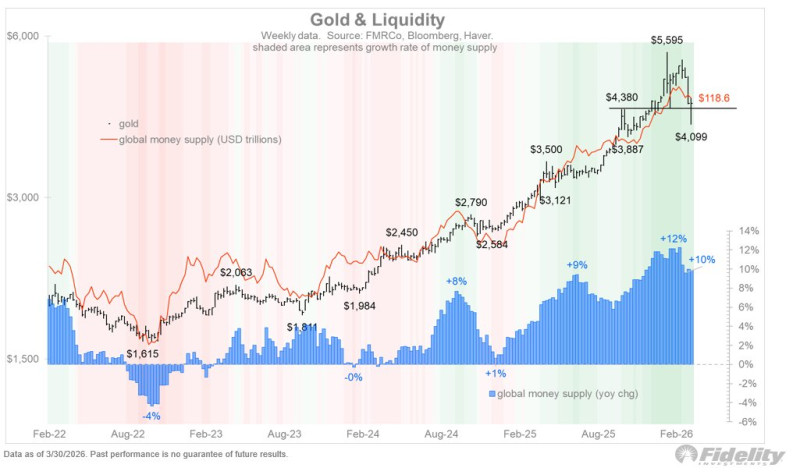
Gold is not behaving in line with expectations during this period, signaling a change in sentiment dynamics.
Instead of accelerating, price is stabilizing - pointing to a short-term shift in how the market is reacting to macro stress. For now, gold sits in a phase where sentiment has cooled, but the underlying trajectory continues to point higher.
Liquidity Pressures Are Reshaping Gold's Role
Global money supply trends continue to show expansion. Historically, this has supported gold's long-term uptrend, which remains visible in the broader structure.
However, the current phase reflects a different dynamic. Rather than functioning as a pure defensive hedge, gold is also being used as a liquidity source under certain conditions - a behavioral shift that helps explain why prices are not rallying aggressively despite supportive macro fundamentals.
In certain conditions, gold is functioning as a liquidity source rather than a defensive hedge - a dynamic that complicates the traditional safe-haven narrative.
Key factors currently at play:
- Geopolitical shock present, but gold momentum has cooled
- Global money supply still expanding, historically bullish for gold
- Gold and Treasuries both acting as liquidity sources in the current phase
- Long-term uptrend structure remains intact
Gold Price Momentum Shift Without Structural Breakdown
While the chart shows a pause in upside momentum, it does not indicate a breakdown of the long-term trend. Gold remains elevated relative to prior years, and the broader structure still reflects a sustained advance.
The current move appears more like consolidation than reversal - price stabilizing after a strong run rather than entering a prolonged decline. Earlier in the cycle, sharp rallies pushed Gold Futures above 4,800, up 7.20% from the March low in a matter of days, underlining how quickly sentiment can shift once conditions align.
The current weakness looks more like a consolidation after a strong advance than the beginning of a structural reversal.
A Gold Market Adjusting to New Dynamics
Gold's recent behavior reflects a broader adjustment in how the asset functions within the financial system. The long-term trend remains intact, and the current softness may simply be part of that recalibration.
For traders and investors, the key distinction is between a sentiment-driven pause and a structural breakdown - and right now, the evidence still leans toward the former.
 Marina Lubimova