Peter Smith

The impact of the Iran conflict is no longer limited to energy markets - it is now hitting one of the most sensitive parts of the global economy: food production. The data suggests that a fertilizer supply shock is already forming, and it could become the next major driver of inflation.
What the data shows
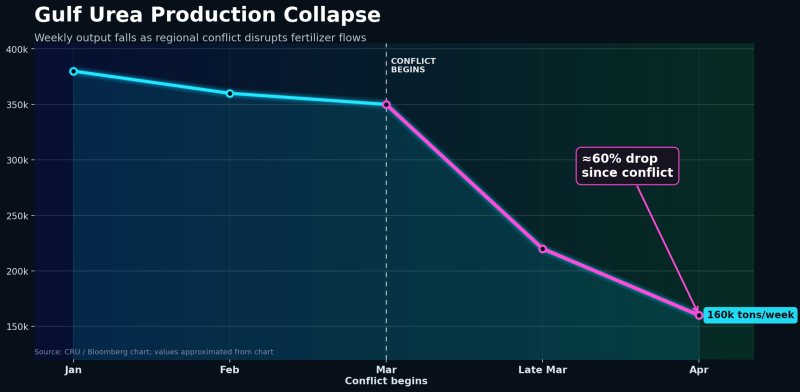
Following the start of the conflict, urea production in the Gulf dropped sharply. Current output is estimated at around 160,000 tons per week, representing a decline of roughly 60% from pre-conflict levels. The chart shows an immediate break lower, followed by sustained weakness into April.
Urea is the world’s most widely used nitrogen fertilizer and a critical input for staple crops such as corn, wheat, and rice. When supply tightens, agricultural costs rise - and those costs are eventually passed through to food prices.
The real bottleneck
The disruption is no longer just about production. Even available supply is struggling to reach global markets. Shipping flows through the Strait of Hormuz have slowed dramatically, leaving a large number of fertilizer vessels effectively stranded inside the Gulf.
This creates a second layer of disruption: supply exists, but cannot be delivered.
A structural supply shock
The Middle East accounts for roughly 45% of global urea trade, meaning any disruption in the region has immediate global consequences. Major importers such as India, Europe, and Brazil depend heavily on these flows, so reduced exports quickly translate into tighter global supply conditions.
What the market is actually saying
Markets are signaling something deeper than a temporary disruption. The combination of falling production, constrained logistics, and rising inventories within the region points to a sustained imbalance. This is not a short-term shock - it is the early phase of a tightening cycle that is likely to push agricultural input costs higher worldwide.
The fertilizer market is entering a stress phase. With Gulf production collapsing and exports constrained, the impact is likely to move quickly into global food prices.
The next wave of inflation may come not from energy, but from agriculture.
 Peter Smith