Marina Lubimova
AI Still Begins With Concrete
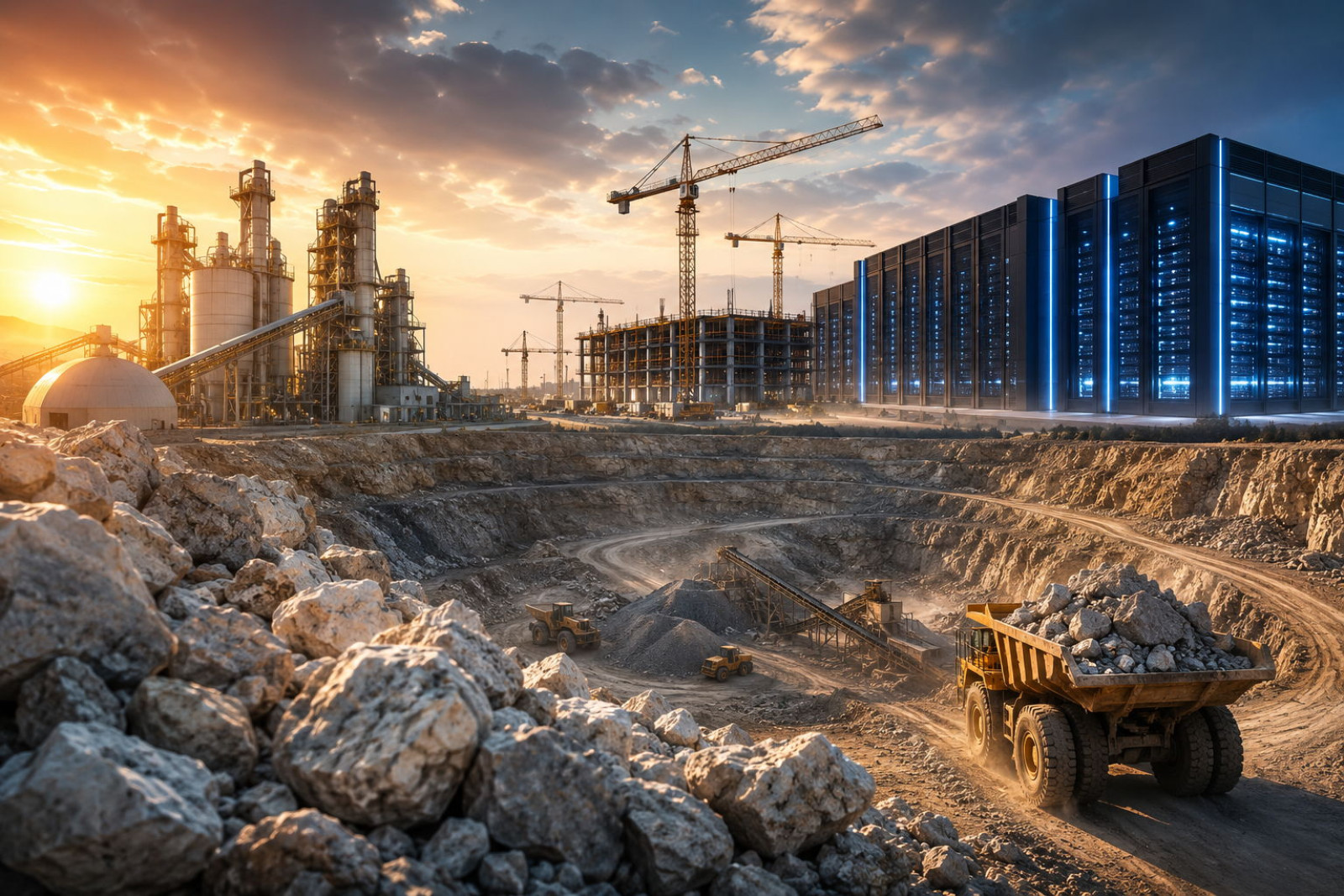
The AI boom is usually measured in GPUs, semiconductor fabs, and data centers. None of them exist without physical infrastructure. Before servers are installed, developers build roads, foundations, substations, water systems and logistics networks. Every one of those projects consumes enormous volumes of aggregates, limestone and lime.
The digital economy may run on software, but it is built from raw materials. That makes Martin Marietta's acquisition of Lhoist North America more than another building materials transaction. It is a bet that industrial minerals will become increasingly valuable as the next investment cycle accelerates.
Buying Time Instead of Capacity
The headline number is $13.5 billion. The more important number is 200 years. Lhoist North America contributes more than 2 billion tons of limestone reserves, an estimated reserve life exceeding two centuries, 20 quarries, 45 distribution terminals, approximately $1.8 billion in annual revenue, and $786 million in Adjusted EBITDA.
Production capacity can be expanded. Long-life reserves cannot. Opening a new quarry often requires years of permitting, environmental reviews, and community approvals. Deposits located near high-growth regions are becoming increasingly difficult to secure, giving existing reserves growing strategic value. Martin Marietta acquired geological scarcity rather than additional production.
The Industrial Map of America Is Changing
The acquisition strengthens Martin Marietta's position across Texas, the Southeast, and the Sun Belt, regions receiving a disproportionate share of America's industrial investment. Semiconductor fabrication plants, hyperscale data centers, LNG export terminals, advanced manufacturing facilities and energy infrastructure are increasingly concentrated in these markets.
Construction materials are expensive to transport, making proximity one of the industry's strongest competitive advantages. Owning reserves near demand is often more valuable than owning additional production elsewhere.
Limestone Has Become an Industrial Material
Limestone is no longer tied primarily to highways and commercial construction. Lime products now support steel production, mining, chemical manufacturing, environmental systems, agriculture, and water treatment, while industrial expansion continues to broaden their applications.
As manufacturing investment shifts back toward North America, these markets provide a more diversified demand base than traditional construction alone. The acquisition expands Martin Marietta's exposure to sectors where industrial activity, not residential housing, drives long-term growth.
The Numbers Support the Strategy
The transaction values Lhoist North America at approximately 15x Adjusted EBITDA, including expected synergies. The consideration includes $7 billion in cash and $6.5 billion in Martin Marietta shares, leaving the Berghmans family with roughly 15% ownership in the combined company and representation on its Board of Directors.
Management expects approximately $85 million in annual cost synergies, with the acquisition becoming accretive to earnings and margins during the first full year. Net leverage is projected to peak near 3.7x before declining below 2.5x within two years through free cash flow generation.
These metrics explain how the transaction is financed. They do not explain why it happened.
Scarcity Is Becoming the Competitive Advantage
Industrial companies once competed by adding production. Increasingly, they compete by controlling resources that are difficult or impossible to replace. High-quality limestone deposits located near major population centers have become scarce. Permitting timelines continue to lengthen, environmental restrictions are tightening, and transporting aggregates over long distances quickly erodes profitability. For producers of construction materials, reserve ownership is becoming a structural competitive advantage rather than a balance-sheet asset.
Beneath Every Industrial Revolution
Martin Marietta did not simply acquire another supplier of lime products. It secured more than two centuries of strategically located mineral reserves supporting the industries reshaping the U.S. economy, from AI infrastructure and semiconductor manufacturing to energy projects, water systems, and industrial reshoring.
Technology may define the next economic cycle. Ownership of the raw materials that make that technology possible may determine who benefits from it most.
 Marina Lubimova