Alex Dudov
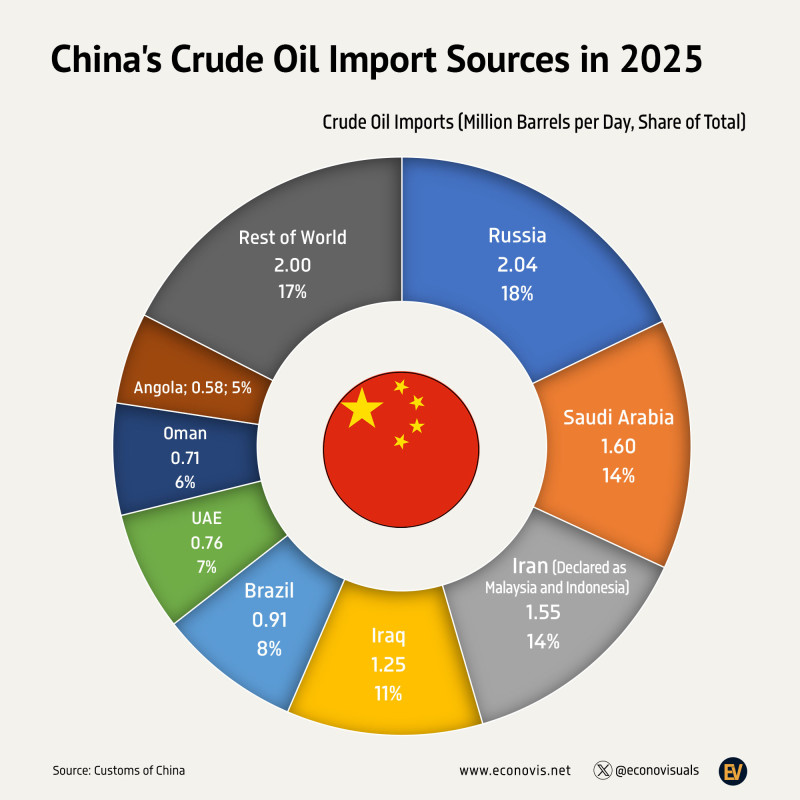
China's crude oil import landscape in 2025 reveals a well-defined hierarchy among global suppliers. According to data shared by Econovis, total inflows reached 11.4 million barrels per day, with supply concentrated among a core group of exporters that span the Middle East, Eastern Europe, and parts of Africa and South America.
Russia holds the top position in this structure - not by a dramatic margin, but by a consistent and measurable lead. The country's role as China's primary crude supplier reflects energy trade relationships that have deepened over recent years, shaping one of the most significant bilateral flows in global oil markets.
Russia and Middle East Countries Lead China's 2025 Crude Oil Imports
The four largest contributors to China's crude oil supply in 2025 account for the bulk of total inflows. Russia leads at 2.04 mb/d (17.9%), followed by Saudi Arabia at 1.60 mb/d (14.0%). Iran comes in third at 1.55 mb/d (13.6%), while Iraq rounds out the top group with 1.25 mb/d (11.0%).
Together, these four countries supply more than half of China's total crude oil intake - a concentration that underscores how strategically important these bilateral relationships are to Beijing's energy security planning.
Secondary China Oil Suppliers Add Depth to the Import Mix
Beyond the leading four, a second tier of exporters contributes meaningful but smaller volumes. Brazil supplies 0.91 mb/d (8.0%), making it the largest non-Middle Eastern, non-Russian supplier in the mix. The United Arab Emirates follows at 0.76 mb/d (6.7%), while Oman adds 0.71 mb/d (6.2%).
Angola rounds out this group at 0.58 mb/d (5.1%). The presence of African and Latin American suppliers alongside Middle Eastern and Russian volumes points to a deliberate diversification strategy on China's part - reducing dependence on any single region while maintaining competitive pricing across its import portfolio.
How Iranian Oil Volumes Are Counted in China's 2025 Data
One notable detail in reading China's import data involves Iranian supply. Some Iranian crude reaches Chinese ports under alternative origin labels - particularly Malaysia and Indonesia - due to sanctions-related shipping arrangements.
Accounting for rerouted Iranian shipments via third countries is essential for understanding the true structure of China's crude oil supply - the formal origin labels don't always reflect the full picture.
When these rerouted flows are factored in, total Iranian supply to China is estimated at approximately 1.55 mb/d for 2025. This adjusted figure aligns with the number presented in the Econovis data and gives a more accurate picture of where Chinese crude is actually coming from, rather than where it is formally declared to originate.
China's 2025 Crude Oil Import Breakdown by Supplier
The full breakdown of China's 11.4 mb/d crude oil import structure in 2025:
- Total imports: 11.4 mb/d
- Russia: 2.04 mb/d (17.9%)
- Saudi Arabia: 1.60 mb/d (14.0%)
- Iran: 1.55 mb/d (13.6%)
- Iraq: 1.25 mb/d (11.0%)
- Brazil: 0.91 mb/d (8.0%)
- United Arab Emirates: 0.76 mb/d (6.7%)
- Oman: 0.71 mb/d (6.2%)
- Angola: 0.58 mb/d (5.1%)
This distribution reflects a supply chain that draws from four continents, with a defined pecking order among contributors. The structure also sits within a broader set of shifting global energy dynamics - including oil's real price ceiling near $385 when adjusted for money supply - factors that continue to influence how major importers like China position their supply relationships going forward.
 Alex Dudov