Sergey Diakov
The U.S - department of the Treasury released the results of its Treasury debt buyback operation on April 22, 2026 - this process shows how the government handles securities and assists market operations. Although the amount of $15 billion is small when compared to the total Treasury market, the structure of the operation and the level of demand provide information about the availability of cash plus how investors are positioned.
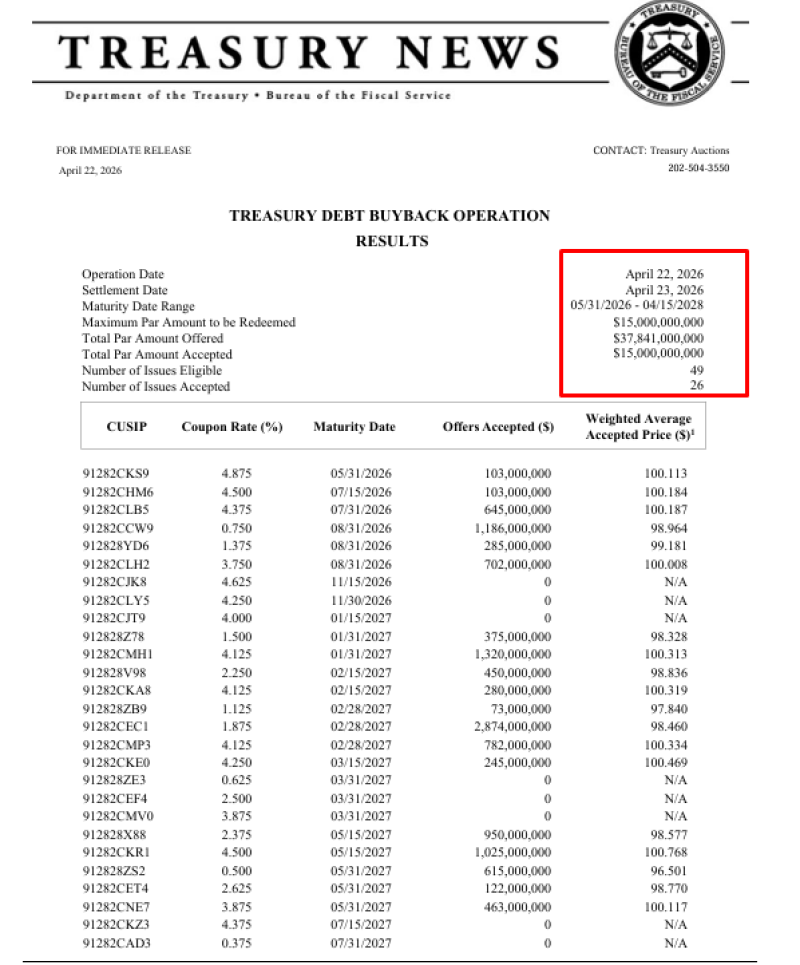
Key Figures from the Operation
| Metric | Value |
| Operation Date | April 22, 2026 |
| Settlement Date | April 23, 2026 |
| Maturity Range | May 2026 - January 2028 |
| Maximum Buyback Amount | $15 000 000 000 |
| Total Offers Submitted | $37 841 000 000 |
| Total Accepted | $15 000 000 000 |
| Eligible Issues | 49 |
| Accepted Issues | 26 |
As the offers were more than 2.5 times the maximum amount, many market participants wanted to sell securities back to the Treasury.
Structure & Execution
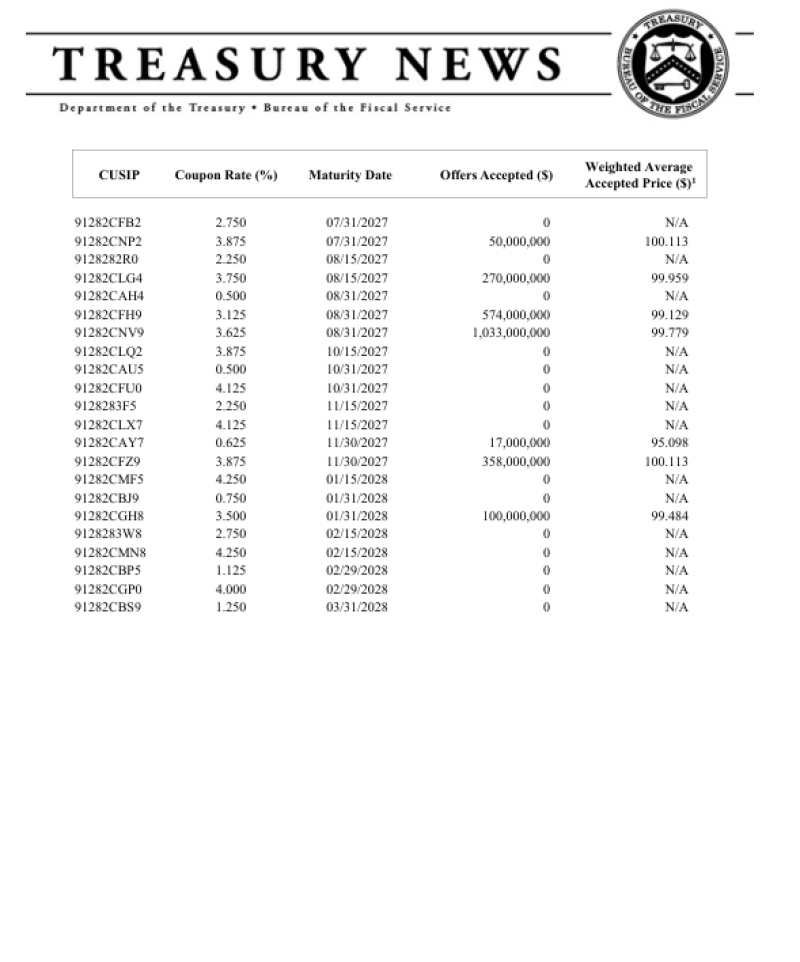
By targeting nominal coupon bearing Treasury securities with short term to intermediate term maturities, the Treasury focused on off-the-run issues - those issues are often more difficult to trade than the most recent benchmarks. If we look at the numbers, only 26 out of 49 eligible securities were selected.
On the list of detailed results, many securities received no allocation at all. To manage the debt, the Treasury concentrated the accepted volumes in a small group, specifically for those maturing in 2027. For individual purchases, the amounts were between small values and more than $1 billion.
And the prices were near the face value of the bonds, usually between 99 and 100. Because some securities were bought at a discount, market conditions were stable and prices were not under pressure.
The Strategy of the Treasury
In this operation, the Treasury uses a technical tool to manage debt instead of a macroeconomic policy. It is changing the structure of its liabilities but also making the secondary market work better.
The strategy includes:
- Reducing the number of different older securities
- Making the dates when debt is due more consistent
- Increasing the ability to trade in segments that are not active
- Assisting the efficiency of the Treasury market for use as collateral
By doing this the Treasury helps the U.S. government bond market stay reliable and deep.
Impact on the Economy
Due to the size of the buyback, the direct impact on the economy is small but the indirect effects are necessary for financial stability.
The operation makes the Treasury market work better - as liquidity and pricing efficiency improve, the costs to trade are lower as well as capital moves through markets with fewer disruptions.
The Treasury strengthens the use of government bonds as collateral when it removes securities that are hard to trade. For banking and institutional funding, this is important because Treasuries are used frequently.
There is no significant change to the total amount of money in the economy. Because the Treasury pays for buybacks - issuing new debt, the process is a change to existing obligations. It is not an addition of new money. As a result the effect on the macroeconomy is neutral or slightly helpful.
The high number of offers shows that market participants were ready to change their holdings - this suggests that there is a demand for cash and flexibility. It is clear that the operation happened when conditions were stable.
Market Interpretation
From a market view, the buyback is a technical measure that creates stability. It assists the Treasury market but does not mean that money is becoming easier or harder to get.
For bond markets the operation provides help in specific maturity ranges. On the U.S. dollar, the effect is very small because interest rates or economic data are more important. For assets like stocks and cryptocurrencies, the impact is indirect and small.
Conclusion
To manage debt the Treasury used a controlled next to specific method on April 22, 2026. With high participation and selective choices, the Treasury is making the market structure better. It is not reacting to a crisis.
By maintaining efficiency and liquidity, the Treasury continues its work on the government bond market - this is not a shift in policy or a stimulus.
 Sergey Diakov