Artem Voloskovets
The Nasdaq Composite gained 2.0%, comfortably outperforming the S&P 500 (+1.1%) and the Dow Jones Industrial Average (+0.7%). Instead of retreating from risk, investors added exposure to the companies most closely tied to artificial intelligence.
The session wasn't defined by stronger economic data or a dovish Federal Reserve. It reflected something more important: capital continues flowing toward businesses expected to build the next generation of AI infrastructure.
Buyers Took Control Early
The session began with weakness. Selling pressure pushed the Nasdaq lower shortly after the opening bell, extending the cautious tone that followed last week's decline. That changed quickly. By late morning the index had recovered, and buying intensified through the afternoon until the Nasdaq closed near its intraday high.
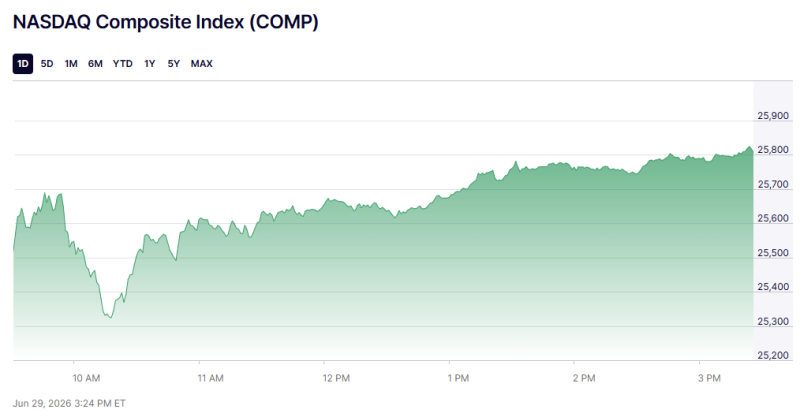
Early selling gave way to steady buying throughout the afternoon, pointing to fresh institutional demand rather than a short-covering rally.
Markets often reveal more through their behavior than their headlines. Monday's reversal showed that investors viewed early weakness as an opportunity rather than a warning.
Half a Trillion Dollars Changed the Conversation
The most influential announcement of the day didn't come from Washington or the Federal Reserve. Samsung Electronics and SK Hynix unveiled plans to invest roughly $518 billion in a semiconductor manufacturing hub designed to support future AI demand.
That figure matters because it extends well beyond South Korea. Every fabrication facility requires advanced lithography systems, semiconductor manufacturing equipment, memory chips, networking hardware, and AI accelerators. A single investment program creates years of demand across the entire semiconductor supply chain.
The market responded accordingly. Applied Materials surged 11.5%, lifting its gain this year to roughly 172% as investors continued to favor companies positioned to benefit from expanding chip production.
Money Flows Are Becoming as Important as Fundamentals
Another catalyst arrived from a very different direction. SpaceX advanced 6.8% after Nasdaq confirmed the company will join the Nasdaq-100 on July 7. The announcement matters less because of the index itself than because of what follows. Funds tracking the Nasdaq-100 will have to buy the stock. Those purchases are mechanical, not discretionary, creating demand regardless of valuation or market sentiment. Passive investing has grown large enough that index changes now automatically move billions of dollars. That structural demand has become part of the investment case.
Oil Failed to Change the Narrative
Energy markets offered plenty of reasons for caution. Brent crude climbed 1.8% to $73.91, while WTI gained 2.2% to $70.75 as traders monitored developments around the Persian Gulf. Equity investors largely ignored the move. Attention shifted instead to reports that diplomatic discussions between the United States and Iran could resume, reducing fears of prolonged disruption around the Strait of Hormuz. The market focused on where energy prices may be heading rather than where they were on Monday.
Bond Markets Quietly Added Support
Treasury yields also moved in a favorable direction. The yield on the U.S. 10-year Treasury eased to around 4.38%, down from roughly 4.56% earlier this month. For companies whose earnings are expected to arrive years into the future, even modest moves in long-term yields can have a meaningful effect on valuations. That remains one of the strongest arguments supporting AI-related equities.
Capital Has Found Its Priority
Monday's rally wasn't remarkable because technology stocks outperformed. Technology has led the market for years. The difference is that investors largely dismissed risks that would have dominated previous market cycles. Rising oil prices, geopolitical uncertainty, and elevated valuations all took a back seat to one number: $518 billion. That announcement reinforced a trend already reshaping global markets. Capital spending on artificial intelligence continues to accelerate, and investors increasingly treat those investments as stronger indicators than short-term macroeconomic noise.
 Artem Voloskovets