Artem Voloskovets

Robert Kiyosaki is known for making bold market calls, but rarely for revising them. This time, he did exactly that. As gold retreated from its record highs, the Rich Dad Poor Dad author admitted he had been wrong about the market's short-term direction. Even so, he reiterated that gold could still reach $35,000 per ounce within roughly five years.
The admission shifts the conversation away from a single prediction and toward a broader issue: how much weight should investors give to short-term price action when evaluating a long-term investment thesis?
Corrections Don't Automatically End Bull Markets
Strong trends rarely unfold without interruptions. Bitcoin has lost more than 70% several times before recovering to new highs. Nvidia has experienced repeated declines of 30–60% while remaining one of the decade's best-performing stocks. Gold has also gone through extended periods of weakness before resuming its advance.
A correction may signal the end of a rally, but it can also represent nothing more than a pause within a larger trend. Kiyosaki's latest comments reflect that distinction. He isn't arguing that gold avoided a correction. He's arguing that the correction doesn't invalidate the broader investment case.
One Forecast Missed the Schedule, Not the Direction
In July 2024, Kiyosaki predicted that gold would rise from roughly $2,400 to around $3,300 by August 2025. The market followed a less predictable path, but the larger trend proved bullish as gold climbed to fresh all-time highs before entering its current pullback.
That history helps explain why Kiyosaki remains focused on structural drivers rather than recent price movements. His latest forecast assumes that those long-term forces remain intact despite increased volatility.
Perspective Changes With the Timeframe
Daily price moves often dominate financial headlines because they are easy to measure. Long-term trends tell a different story.
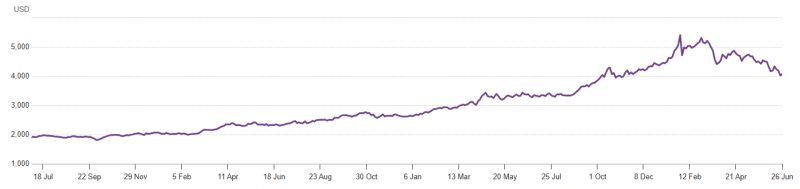
The chart illustrates both perspectives. From its peak above $5,300, gold has retreated toward the $4,100 range, a correction of roughly 20–25%. Measured from mid-2023, however, the metal has still risen from around $1,900, leaving prices more than twice as high as they were only a few years ago. The same chart can therefore support two opposing narratives: one centered on the recent decline, the other on the broader upward trend.
Why Pullbacks Feel More Important Than They Are
Sharp declines tend to reshape investor expectations faster than steady advances. Negative news becomes more prominent, forecasts grow more cautious, and recent losses begin to overshadow longer-term performance. This tendency explains why corrections often trigger emotional decisions even when the underlying investment case has changed very little. Kiyosaki's approach is built around the opposite assumption. Rather than treating falling prices as evidence that an asset has become less attractive, he views them as opportunities to accumulate positions if the original thesis remains intact.

 Artem Voloskovets