Artem Voloskovets

Oil markets are shifting gears. After an aggressive run-up, Brent crude is showing clear signs of losing upside momentum - and the chart tells that story bluntly. Robin Brooks pointed out that policy signaling is actively working to cap oil prices, cutting off the kind of panic-driven demand that typically fuels the sharpest rallies. That dynamic is now written into the price action.
Policy signaling is helping cap oil prices by preventing panic-driven surges, which historically act as a key driver of sharp rallies.
Brent Crude Rally Stalled Near $140 After Sharp Climb
The chart lays out a textbook uptrend. Brent crude climbed aggressively from below $80 to above $140, building a clean sequence of higher highs and higher lows through March. It was the kind of move that draws momentum traders in and keeps them there - until it doesn't.
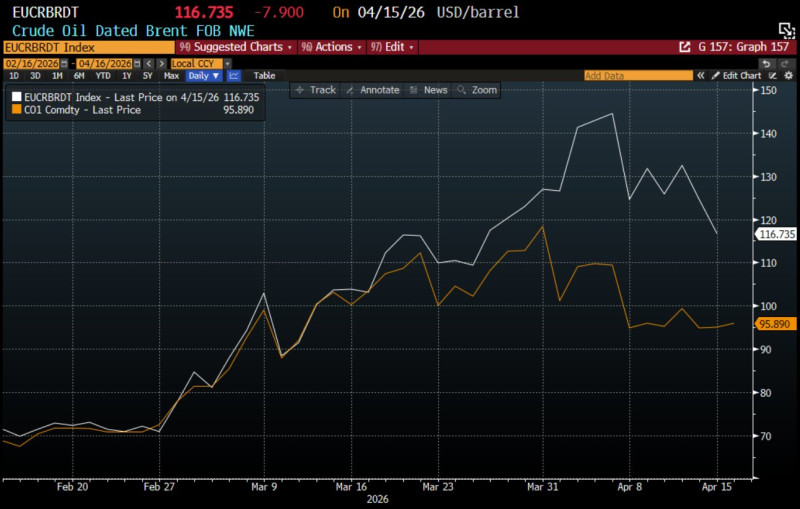
That sequence has now broken down. After peaking, Brent failed to hold its highs and pulled back toward the $116 area. The rhythm of continuation is gone. Buying pressure that defined the rally phase is no longer dominant, and the market is reflecting that in real time. Analysts tracking Brent Oil Backwardation Signals Near-Term Supply Tightness have noted that the forward curve structure is also shifting in line with this cooling momentum.
The inability to extend higher suggests that buying pressure is no longer as dominant as it was during the rally phase - a transition from expansion into a more controlled structure.
Brent Oil Spread Compression Points to Oil Price Rebalancing
One of the more telling features of the chart right now is the divergence between Brent and the secondary benchmark (orange line), which has been holding around the mid-$90s. While both moved higher initially, Brent accelerated far more sharply - opening a wide spread between the two.
That spread is starting to compress. Brent's retreat toward $116 looks less like a breakdown and more like a rebalancing - price beginning to realign with broader market conditions rather than running ahead of them. Context worth considering: Oil Shock Inflation Seen as Temporary as Markets Price 2026 Spike, which suggests the market isn't pricing in a structural shift - just a near-term adjustment.
The divergence isn't resolved yet, but the direction of travel is clear.
Controlled Upside Replaces Panic Buying in Oil Markets
What the chart no longer shows is panic. The steep climb has given way to a flatter structure where highs are no longer being extended. That's consistent with an environment where upward pressure is being deliberately capped rather than allowed to run.
Without the kind of volatility that typically drives oil spikes, the trend becomes more measured - and a lot less explosive.
Brent remains elevated by any historical measure, but the structure is telling a different story now. Continuation from here isn't about riding prior strength - it would require fresh momentum to materialize. Some of the supply-side context comes through in data like Russia Tops China's 11.4 mb/d Crude Oil Import Mix in 2025, which adds color to why the fundamental picture remains complex even as price momentum fades.
 Artem Voloskovets