Artem Voloskovets
The global profit hierarchy is no longer stable. What used to be dominated by consumer tech giants is now being reshaped by a single force: AI infrastructure. The data shows a clear pattern - profit growth is concentrating in companies closest to AI demand, and no company is benefiting more than Nvidia.
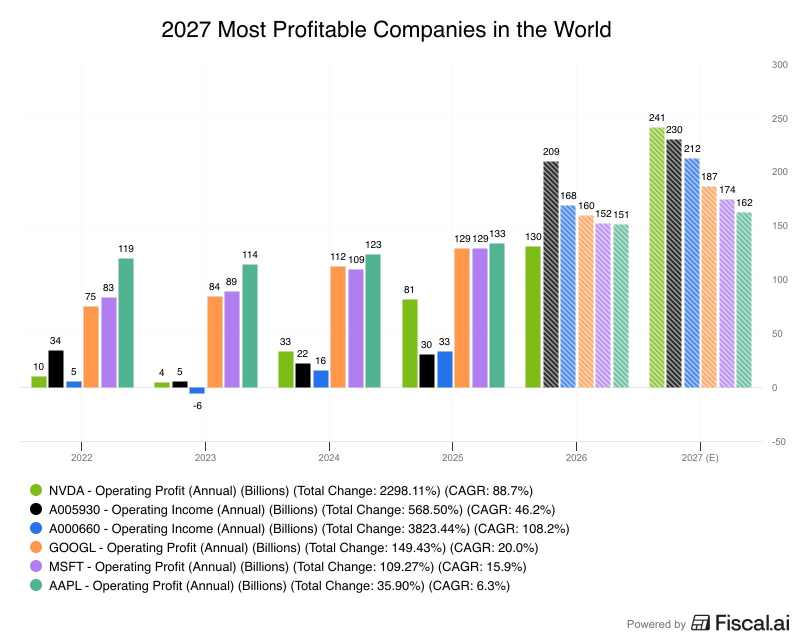
From 2022 to projected 2027 numbers, Nvidia’s operating profit rises from roughly $10B to around $241B. That implies a more than 20x increase in just five years.
As noted by Fiscal.ai:

That detail adds important context — the leaderboard is not just shifting at the top, it is being reshuffled across the entire stack.
From 2022 to projected 2027 numbers, Nvidia’s operating profit rises from roughly $10B to around $241B. That implies a total increase of more than 20x in just five years.
By comparison:
- Apple grows steadily but modestly
- Microsoft and Alphabet show consistent but far slower expansion
- Amazon rebounds sharply but remains behind the leaders
The gap is not just widening - it is accelerating.
This is not normal growth
What stands out is not just Nvidia’s size, but its trajectory. The company is showing a CAGR approaching ~90%, which is virtually unheard of at this scale. Meanwhile, traditional tech giants are growing in the range of mid-teens to low-twenties percentages.
This creates a divergence where one company compounds exponentially while others grow linearly.
Profits are moving upstream
The data suggests a deeper structural change: profits are moving from platforms to infrastructure.
For over a decade, value in tech was captured at the application layer - devices, software ecosystems, and consumer platforms. Now, the bottleneck has shifted. AI requires compute. Compute requires chips. And chips are controlled by a small number of suppliers, with Nvidia at the center. This is why profit is concentrating upstream.
Who loses in this model?
If profits are moving upstream, it implies pressure downstream. Companies built around end-user distribution - devices, apps, and SaaS layers - are no longer the primary capture point of value. Instead, they are becoming increasingly dependent on the infrastructure they do not control.
Apple remains one of the most profitable companies in the world, but its growth is relatively flat compared to AI-driven players. The same applies to large software ecosystems like Microsoft and Alphabet, which are now forced to spend aggressively on AI infrastructure just to maintain their position.
For SaaS and application-layer companies, the pressure is even more direct. AI reduces the cost of building software, compresses pricing power, and shifts differentiation away from features toward access to compute and data.
The result is a reversal of the previous cycle. For years, applications captured the majority of value built on top of infrastructure. Now, infrastructure is capturing the majority of value built on top of applications.
Markets are repricing the AI stack
Markets are effectively pricing in a new reality: the companies that enable AI are more valuable than the companies that use it.
While firms like Apple and Microsoft still generate massive profits, their growth is no longer defining the frontier. Instead, the frontier is being set by companies that supply the core infrastructure powering AI expansion.

The implication
If this trend holds, the definition of “Big Tech” will change. It will no longer be about who has the most users or devices - but about who controls the compute layer of the global economy.
Nvidia is not just growing faster - it is changing where profits in technology are generated. The AI era is shifting value upstream, and the companies closest to the infrastructure are capturing the largest share of it.
 Artem Voloskovets